The AI slop loop, and how I write with AI anyway
41% of long-form LinkedIn posts are fully AI-generated and platforms ship buttons to report it. The tell isn't one phrase, it's uniformity. My rules for using AI without sounding like it, including the ones I break.
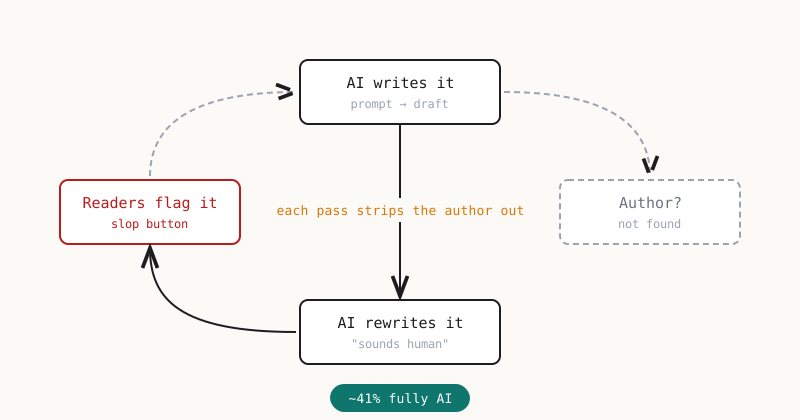
TL;DRAI writes → second AI humanizes → readers flag it anyway. Each pass strips more of the author out. The fix is boring: outline first, source every claim, read it aloud, break the rhythm. The model can structure. It can't have been there.
LinkedIn added a "Seems like AI slop" button.
Same LinkedIn that spent years putting an "Enhance with AI" button under every text box.
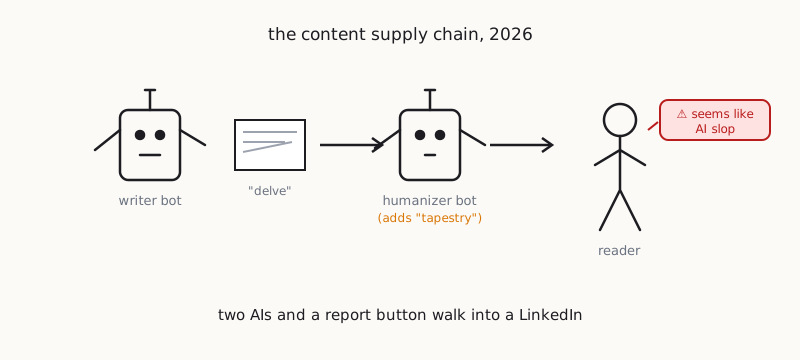
Pangram scanned over a million posts and found ~41% of long-form LinkedIn content is fully AI-generated. Elsewhere, someone built a local translator to rewrite Claude's answers in plain English. A second AI, hired to explain the first one.
I wish the absurdity ended there. It doesn't: the detection button and the generation button live in the same UI, one scroll apart.
The tell is never a phrase
Banned-phrase lists miss the point. You can delete "delve" and "moreover" and still ship something that reads like a brochure. The actual tell is uniformity:
- Even sentence lengths
- Even paragraph shapes
- Even enthusiasm, spread evenly across every line
Real writing is lumpy. Some thoughts end mid-breath. Some paragraphs carry three numbers and no adjectives.
My rules
I write with AI daily. MR comments, docs, posts like this. The rules that keep it mine:
AI drafts from my outline, never the reverse. If the model picks the structure, the structure is the average of everyone else's.
Every claim carries a number and a named source. "Most teams" is slop. "46% of 600+ engineering leaders" is a fact. No source, no claim.
Read it aloud and break the rhythm. Where two sentences have the same shape, one gets cut to a fragment. Some thoughts just end. That's allowed.
No sentence I wouldn't say out loud to a teammate. "Leverage my expertise" fails. "I got tired of this" passes.
FROM PRODThe funniest part of the slop economy: the humanizer tools train on human writing, the generators train on human writing, and the detectors train on the output of both. Three models, one group project, zero authors.
"Tests for text" don't exist
The engineering instinct is to automate the check. For prose there's no linter that catches "nobody said anything". A grammar-clean post with no person in it passes every static check. That's exactly what the detection button is for.
The closest thing to a test: would the specific people I work with recognize this as mine? Not "is it good". "Is it mine." If a sharp reader could attribute it to anyone, it's not done.
The loop to avoid
AI writes → second AI humanizes → readers flag it anyway. Each pass through the loop strips more of the author out. The end state is content with no person in it.
The fix is boring: put the person in first. Opinions, numbers, and the weird specific detail only you have. The model can structure it. It can't have been there.
If my own posts ever fail that test, the slop button deserves me.
Further reading
- Pangram's LinkedIn AI-content study
- MIT Media Lab, "Your Brain on ChatGPT" (the cognitive debt paper)
- Adoption vs transformation: the engineering version of the same argument