What a Frontend Center of Excellence actually does
A CoE isn't a committee that writes guidelines nobody reads. Ours aligns frontend decisions across product teams: standards with reasons, tooling as enforcement, review at the architecture layer. What worked, and the failure mode to avoid.
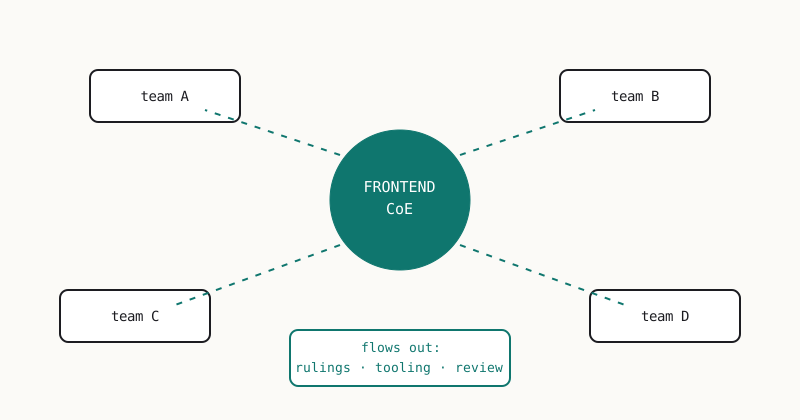
TL;DRA working Frontend CoE = one ruling applied everywhere, tooling that enforces it, architecture-level review, and members who keep shipping features. The failure mode is a standards document growing while product impact stays flat. If it can't point to fewer duplicated abstractions and faster onboarding, it's a book club.
"Center of Excellence" has a branding problem. It sounds like a committee that produces guidelines nobody reads.
Ours at Instaffo keeps frontend decisions aligned across product teams: shared standards, shared tooling, one direction. It works because of what it does daily, not what it's called. The honest version:
What it is
A small group with a frontend-wide mandate, embedded in feature work instead of above it:
- Standards with teeth. Decisions like state patterns, server/client boundaries, and styling get a ruling and a reason. The reason matters. A ruling without its why gets relitigated every quarter.
- A shared platform. Design system, lint configs, templates, performance budgets. Teams consume them instead of re-deriving them.
- Review at the architecture layer. Not line-by-line nitpicks. Whether a design holds. New features get a judgment pass on seams and state before implementation hardens them.
What it is not
- Not an approval gate. Teams ship; the CoE advises before and audits after.
- Not a documentation project. Standards live next to the code they govern.
- Not a career parking lot. Rotation through the CoE is a development track, not a silo.
FROM PRODYou can measure a CoE by its artifacts-to-decisions ratio. Guidelines nobody can accidentally violate don't need policing. Documents nobody can accidentally follow need a rethink.
What moved the needle
- One ruling, applied everywhere. The value was consistency: one answer to "how do we do X" that every team could build on.
- Mentoring through review. Architecture reviews doubled as teaching. Engineers took the reasoning back to their teams.
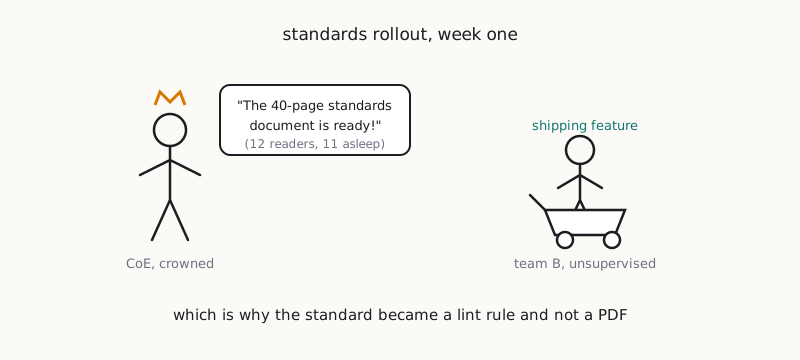
- Tooling as enforcement. Where a standard could be a lint rule or a template, it became one.
That third one is the whole trick. Enforcement through tooling converts a standards document from "something to read" into "something that happens".
The failure mode to avoid
The gravity pulls toward abstraction: standards documents growing while product impact stays flat. The countermeasure is simple: the CoE keeps shipping features. Credibility comes from being in the arena.
The scoreboard
Alignment isn't warm feelings. Ours shows up as: fewer duplicated abstractions across teams, faster onboarding onto any codebase, and frontend decisions that stop being relitigated.
If a CoE can't point to numbers like that, it's a book club. Possibly a good one. But be honest about which one you funded.